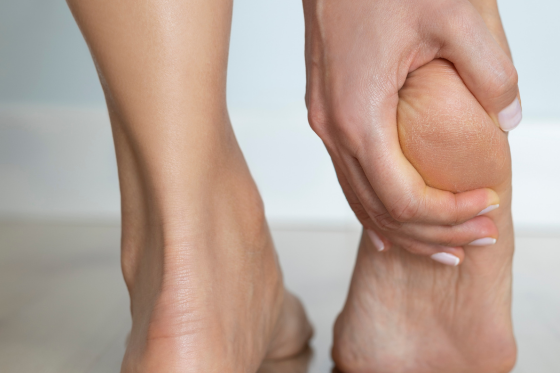
The Footwear Audit: What’s on Your Feet and What It’s Costing You

Most people with heel pain buy at least one pair of shoes hoping it will fix things. Many buy three or four. It rarely works, for a reason that’s worth understanding: footwear doesn’t cure plantar heel pain. Footwear changes the demand on the tissue — which is genuinely useful, sometimes dramatically so, but it’s one half of an equation. The other half is building the tissue’s capacity to tolerate demand, and no shoe does that for you. That said, the footwear half is frequently mishandled. So here’s a practical audit — what actually matters in a shoe, how to assess what you already own, and where the real problems usually hide.

The Back of Your Heel Plays by Opposite Rules

There’s a specific way this goes wrong. Someone develops pain at the back of the heel. They look it up, find the standard Achilles exercise — heel drops off the edge of a step, letting the heel sink down below the level — and start doing them diligently. Three sets, twice a day, for weeks. It gets worse.

The Loading Program, Explained: What the Research Actually Prescribes

Most people with heel pain have been told to stretch. Far fewer have been told to load. That’s a meaningful gap, because the most-cited trial in this area compared exactly those two approaches — and the loading group got better considerably faster. This article walks through what that program actually involves: the technique, the dosage, the progression, how to know whether you’re doing too much, and the mistakes that cause it to fail. It’s the level of detail most articles skip.

How to Tell If You’re Getting Proper Lymphedema Care

Lymphedema care varies enormously in quality, and most people have no way to judge what they’re receiving. If your treatment is a compression stocking handed over without measurement, or a massage that feels pleasant but changes nothing, or an instruction to elevate your leg and come back in six months — you may reasonably assume that’s what treatment looks like, because you have nothing to compare it against.

The Swollen Leg: Reading the Signs

Leg swelling is one of those symptoms that gets normalized quickly. It’s worse by evening, it improves overnight, your shoes have been tighter for a couple of years, and somewhere along the line you stopped mentioning it. But a swollen leg is not one condition. It’s a symptom with a long list of possible causes, and they’re distinguished less by how much the leg is swollen than by a handful of specific, observable features. This article works through those features one at a time. It won’t tell you what you have — only an examination can do that — but it will help you notice the things that actually matter and describe them accurately to a clinician.

Fibromyalgia: Why Your Body Feels Constantly Achy, Tired, and Overwhelmed – and What You Can Do About It

At Highland Physical Therapy, Kimberley Schwarze and her team regularly work with people navigating fibromyalgia. One of the most common things we hear is: “I just don’t feel like myself anymore.” This blog is here to help you understand what fibromyalgia is, why your body feels the way it does, and how you can begin to take back control in a way that feels supportive and realistic.

Ready to Move More This Spring? Here’s How to Protect Your Knees

At Highland Physical Therapy, this is a pattern we see every year. The encouraging news is that with the right approach, you can stay active, support your knees, and avoid unnecessary setbacks. This guide will help you understand why knee discomfort often appears in spring and what you can do to move confidently through the season.

Why Your Knee Pain Might Be Holding You Back And What You Can Do About It in Pocatello

At Highland Physical Therapy, we regularly work with individuals across Pocatello who are dealing with knee concerns that have built up over time. The encouraging news is that many of these issues can be addressed with the right approach, helping you move more freely and confidently again. This guide will walk you through why knee discomfort happens, what your symptoms may be telling you, and what steps you can take to support long term movement and function.

Knee Pain in Late Winter: Why February Aches Happen and How to Get Ready for Spring

A man struggles with his knee pain

At Highlands Therapy, we see a clear seasonal pattern. Late winter is one of the most common times people seek help for knee pain. The good news is that this time of year is also one of the best opportunities to address it before spring fully arrives.